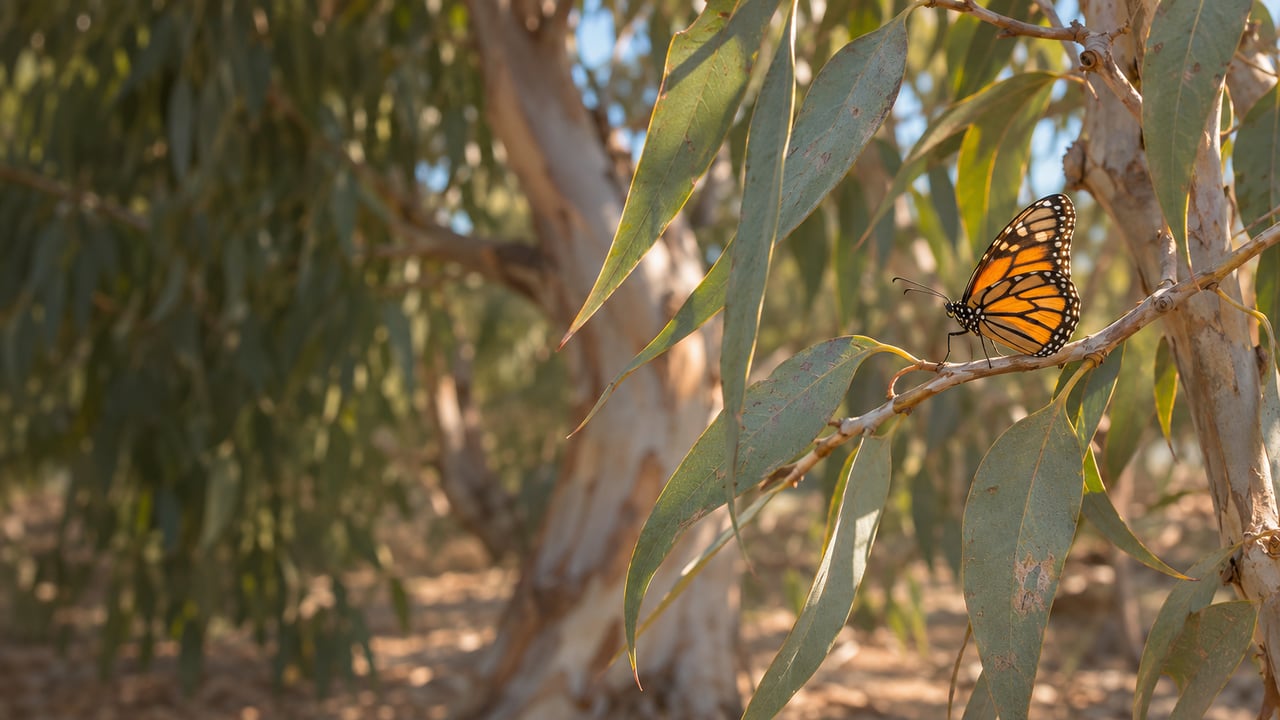
At 11:30 a.m. on October 26, a receiver picked up a monarch butterfly at Platform Harmony, the offshore oil platform about 15 miles west of Goleta. Two hours later the same butterfly was roosting in a eucalyptus tree beside Sandpiper Golf Course, at the edge of the Ellwood overwintering area. Craig Wakamiya had followed her signal there with the Project Monarch app, found her in the branches and photographed her.
Her tag reads WR087, and her name is Lulu. A few years ago a single monarch at Ellwood would have been lost among thousands. This winter the grove holds few enough butterflies that some of them have names, tracking histories and a public map you can check from your phone before you leave the house.
Thirty-Nine Days From Idaho
Lulu was reared and released at Mountain Home, near Boise, on September 18, 2026. In his account of her trip for Adopt a Monarch, Dr. David James puts it at 625 miles over 39 days. Goleta's Monarch Press says she landed at Sandpiper Golf Course after a tracked flight of more than 600 miles. According to Dr. James's account, the tag recorded this route:
- She crossed the Sierra Nevada and reached the San Joaquin Valley near Porterville on October 8.
- She flew northwest to Fresno by October 10, then turned west and southwest.
- She reached the coast at San Simeon three days later and followed it south, passing the overwintering sites at Cambria, Morro Bay and Pismo Beach.
- She spent two days among the flowers around Santa Maria.
- On October 19 she reached the coast just south of Vandenberg Space Force Base, then went undetected for a few days.
- On October 26 she was picked up at Platform Harmony, 6.4 miles offshore, and two hours later at Sandpiper.
She passed up several well-known roosts and ended up at Ellwood. If Lulu stays non-reproductive she may spend the winter there. Her sister, Mary Alice, was released at the same Idaho site 11 days earlier, flew about 500 miles southwest to Newark in the Bay Area and has started breeding there. The two sisters show how differently western monarchs from the same place can behave in the same fall.
How Small the Grove's Numbers Have Become
One butterfly carries this much weight at Ellwood because of the counts. Dr. James writes that Ellwood has historically hosted up to 50,000 overwintering monarchs, but in the past few years fewer than 30. The City of Goleta puts the decline of the migratory western population at 95% since the 1980s.
| Moment | Count | Who reported it |
|---|---|---|
| Ellwood, historic high | Up to 50,000 | Dr. David James, Adopt a Monarch |
| Ellwood, 2020 season | 10 | Santa Barbara Independent |
| Ellwood season high, October 2025 | 20 | Santa Barbara Independent |
| Ellwood, 2025 Xerces mid-season count | 29 across nine sites | Xerces Society |
| Ellwood, January 2026 city count | 2 across all sites | Santa Barbara Independent |
| Ellwood, October 26, 2026 | About 30, Lulu included | Craig Wakamiya, via Adopt a Monarch |
Across California, the Xerces Society's 2025 mid-season count recorded about 12,260 monarchs at 249 sites. The late-season survey that ended January 11, 2026, found 6,464 at 193 sites.
The low numbers are not a fixed trend. In the Independent's January report, biologist Charis van der Heide pointed back to 2020, when Ellwood counted only 10. The next year the California population unexpectedly rebounded to almost a quarter million. "I would say it could go either way," she told the paper. "They could bounce back remarkably again, or this could be our new normal, which would be devastating."
With 30 butterflies on the mesa instead of thousands, a cluster is hard to find, and an individual monarch with a known route is easy to follow.
The Tags That Turned Ellwood Into a Map
Last season was the first time Ellwood monarchs carried radio tags. Van der Heide told KCLU that the transmitters weigh 0.07 grams and have a small solar panel and a little antenna. The Santa Barbara Independent reported in December 2025 that each tag costs $200 and that five Ellwood monarchs had been tagged, part of more than 400 tagged nationwide that year.
The City of Goleta also put up a Motus tower, a radio receiver that tracks the tags alongside the Bluetooth detections from phones, Noozhawk reported. One of last season's butterflies, Danny, named for van der Heide's career mentor, stayed close to one spot at Ellwood. By January the count of tagged butterflies in the area had reached 10. Van der Heide told the Independent that some had not been detected for weeks, while a few were still very active.
This fall Ellwood Friends and the monarch scientists at Althouse & Meade plan to tag 10 more monarchs at Ellwood, so Lulu will soon have tagged company. The City lists this tracking among its main jobs at the grove, along with clearing dead and dying trees, restoring habitat and planting thousands of new trees.
Following Them From Your Phone
Wakamiya located Lulu using the detection mode of the Project Monarch app. Project Monarch explains that its tags are detected passively by Motus and Terra receiver stations, by the Project Monarch app and by everyday smartphones. Each detection adds to the record of a butterfly's route, stopovers and timing. The app is free. KCLU reported that the tags connect with anyone running the app within Bluetooth range, and that the app's map shows tagged monarchs up and down the West Coast.
If you walk Ellwood Mesa with the app open, your phone becomes one more receiver. Goleta's Monarch Press encourages residents to download the app and follow the tagged monarchs. Lulu is roosting in trees next to a private golf course. The public trails and viewing areas on the mesa are the place to look for her.
When the Next Few Weeks Matter
The City's grove page describes the season this way. Monarchs reach the coast in October, settle into the most sheltered groves in November, and Ellwood's population generally peaks in mid-December, when the butterflies gather in clusters for protection. By mid-March they are gone. The Xerces Society's early-season count ran October 17 through November 1. Its 2026 mid-season count runs November 14 through December 6, and the late-season count runs December 26, 2026, through January 10, 2027. The mid-season count opens the same weeks the butterflies settle in.
Before you go, here are the practical details from the City's Goleta Butterfly Grove page:
- Hours and cost. The grove is open sunrise to sunset with no admission fee.
- Parking. Free parking is at the Ellwood Mesa Open Space & Sperling Preserve lot, 7729 Hollister Avenue, across from Ellwood Elementary School. The grove is a little over half a mile away, and butterfly trail markers show the route.
- By bus. MTD Line 25 stops at Viajero on Hollister Avenue, near the lot.
- What to bring. The City suggests sturdy shoes and binoculars. A portable restroom is at the lot.
- Weather. The City asks visitors to stay away while it is raining or the ground is muddy after a storm, because of the risk of fallen trees and blocked paths.
- Rules. Stay on designated trails, keep out of roped-off areas, keep dogs leashed and don't bring bikes or horses into the grove.
Some of the mesa looks different than it did a few years ago. The City installed trail and drainage improvements and a temporary footbridge in 2025, and restoration and vegetation management continued in 2026. Its habitat plan calls for rerouting trails, improving two monarch viewing areas and replacing the Devereux Creek boardwalk, while keeping safe public access to the beach during construction. The City is rebuilding its Monarch Butterfly Docent Program and bringing back school field trips. Leonel Mendoza-Diaz, docent coordinator in the Department of Neighborhood Services, handles questions about both.
Putting Your Hands in the Habitat
The tags show where butterflies like Lulu choose to stop, and the restoration work aims to make Ellwood a stop worth choosing. Ellwood Friends and the Santa Barbara Bucket Brigade are working with the City to plant native trees and restore monarch habitat. The next volunteer workday is November 15, and you can register through the Bucket Brigade.
You can also name one of this season's tagged butterflies. Ellwood Friends offers naming for a $1,000 donation toward the tracking research, limited to the first five donors for the 2026 season. One of the 10 butterflies tagged at Ellwood this fall could carry a Goleta neighbor's name onto the same map that showed Lulu's route.
Here at Ally Edwards, we follow Goleta closely, from the trailheads on Hollister Avenue to the eucalyptus where Lulu landed. If the walk out to the grove has you thinking about your own home on this side of town, start with a free home valuation and we'll go over what it means for your plans.